NMR Chemical Shift Basics
Chemistry Tools | June 2, 2026 | 9 min read
How shielding, electronegative atoms, pi systems, integration, and splitting help interpret proton NMR.
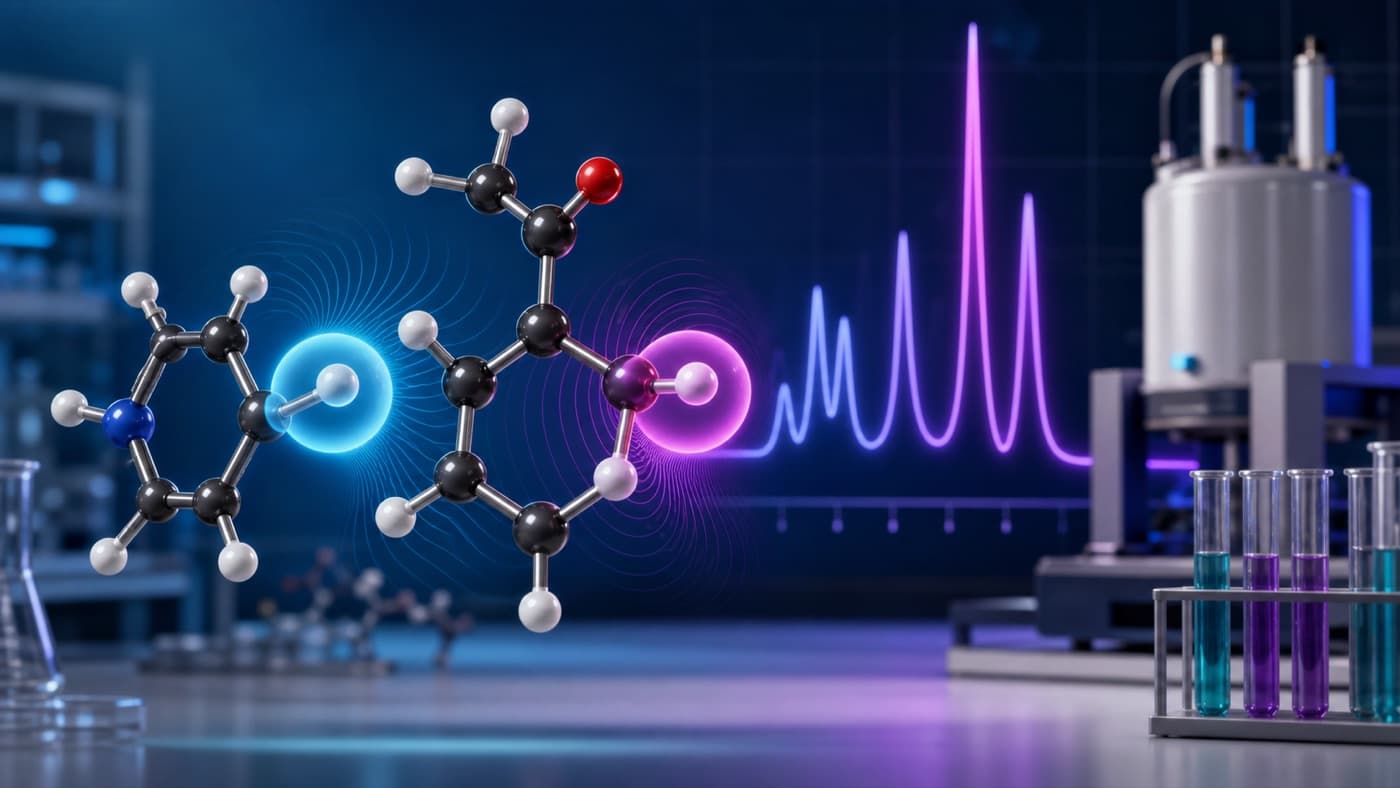
| Region ppm | Common signal | Reason |
| 0.8-1.5 | alkyl H | shielded sp3 |
| 2-3 | next to pi or heteroatom | deshielding |
| 3-4.5 | C-H near O/N/halogen | electronegativity |
| 6-8 | aromatic H | ring current |
| 9-10 | aldehyde H | strong deshielding |
What Chemical Shift Shows
Chemical shift tells you about the electronic environment around a nucleus. Shielded protons appear upfield at lower ppm. Deshielded protons appear downfield at higher ppm.
Electronegative atoms, pi bonds, aromatic rings, and carbonyl groups commonly pull signals downfield. Alkyl environments usually appear upfield.
Integration and Splitting
Integration estimates how many hydrogens contribute to a signal. Splitting shows how many neighboring hydrogens are nearby, often following the n + 1 rule for simple first-order spectra.
A triplet next to a quartet often suggests an ethyl group. A singlet with three hydrogens may indicate a methyl group with no neighboring hydrogens.
Avoid Overconfidence
NMR interpretation is pattern-based but not automatic. Overlapping peaks, symmetry, exchangeable protons, and solvent effects can complicate a spectrum.
Use chemical shift, integration, splitting, and molecular formula together. Any one clue alone can mislead.
Useful Site Tools
The Proton NMR Prediction and Carbon NMR Prediction pages are listed as coming-soon tools for spectroscopy support.
Practice With the Free Calculators
Reading the method is step one — running real numbers through it is what makes it stick. These free tools pair well with this guide: